Delving into the realm of capital growth, this topic uncovers the secrets behind investment growth, offering a journey filled with valuable insights and practical examples.
From understanding the concept to calculating its significance, this discussion sheds light on the factors influencing capital growth in investments.
What is Capital Growth?
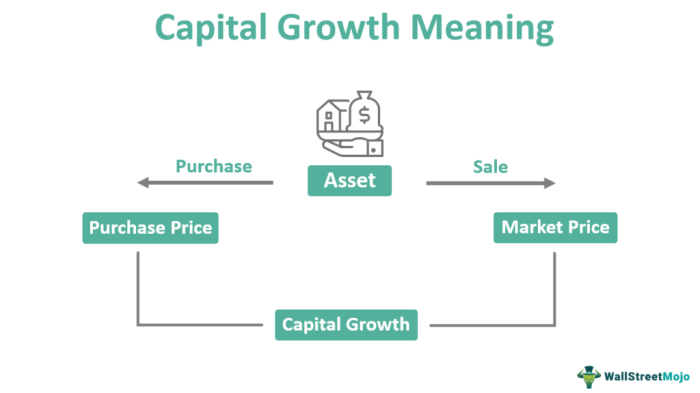
Capital growth refers to an increase in the value of an investment over time. This can result from various factors such as market conditions, demand, and the overall performance of the asset.
Assets with Capital Growth
- Real Estate: Properties tend to appreciate in value over time, especially in high-demand areas.
- Stocks: Shares of companies can increase in value based on the company’s performance and market conditions.
- Collectibles: Rare items such as art, antiques, or vintage cars can experience capital growth as their demand and value rise.
Factors Influencing Capital Growth
- Economic Conditions: The overall health of the economy can impact the growth or decline of investments.
- Market Demand: Assets in high demand are likely to experience capital growth as their value increases.
- Company Performance: For stocks and other investments tied to companies, strong performance can lead to capital growth.
- Inflation: Inflation can also contribute to capital growth as the value of assets increases to keep up with rising prices.
How is Capital Growth Calculated?
When it comes to calculating capital growth, it involves determining the increase in the value of an investment over a specific period of time. This is an important aspect for investors as it helps them assess the performance of their investments.Explain the formula used to calculate capital growth:
Formula for Calculating Capital Growth
Capital Growth Rate = ((Current Value of Investment – Initial Value of Investment) / Initial Value of Investment) x 100
Capital Growth Rate = ((Vf – Vi) / Vi) x 100
Where:
- Capital Growth Rate: The percentage increase in the value of the investment
- Current Value of Investment (Vf): The current worth of the investment
- Initial Value of Investment (Vi): The initial cost of the investment
Explain the significance of compounding in capital growth:
Significance of Compounding in Capital Growth
Compounding plays a crucial role in capital growth as it allows investors to earn returns not only on their initial investment but also on the returns generated over time. This results in exponential growth of the investment over the long term.
Provide a step-by-step example of calculating capital growth:
Example of Calculating Capital Growth
Let’s say you invested $10,000 in a stock and after a year, the value of your investment increased to $12,
000. To calculate the capital growth rate:
- Initial Value of Investment (Vi) = $10,000
- Current Value of Investment (Vf) = $12,000
- Capital Growth Rate = (($12,000 – $10,000) / $10,000) x 100
- Capital Growth Rate = ($2,000 / $10,000) x 100
- Capital Growth Rate = 0.2 x 100
- Capital Growth Rate = 20%
Capital Allocation
Capital allocation is the process of distributing an investment portfolio among different asset classes or securities based on specific criteria. It plays a crucial role in determining the risk and return profile of a portfolio, as well as achieving investment objectives.
Importance of Capital Allocation
Effective capital allocation is essential for optimizing portfolio performance and managing risk. By diversifying investments across various asset classes, investors can reduce the impact of market volatility on their overall returns.
- Ensures optimal risk-adjusted returns
- Helps in achieving long-term financial goals
- Mitigates concentration risk
Approaches to Capital Allocation
There are different approaches to capital allocation, each with its own set of advantages and considerations:
- Strategic Asset Allocation: Involves setting target allocations for different asset classes based on long-term objectives and risk tolerance.
- Tactical Asset Allocation: Involves making short-term adjustments to the portfolio based on market conditions and economic outlook.
- Dynamic Asset Allocation: Combines elements of both strategic and tactical allocation strategies, allowing for more flexibility in response to changing market dynamics.
Relationship between Capital Allocation and Portfolio Diversification
Capital allocation is closely linked to portfolio diversification, as it involves spreading investments across various asset classes to reduce correlation risk and enhance risk-adjusted returns.
Portfolio diversification is the practice of spreading investments across different asset classes to reduce exposure to any single investment and minimize overall risk.
In conclusion, What is Capital Growth? emerges as a crucial element in crafting successful investment strategies, emphasizing the importance of smart capital allocation and diversification.
FAQ Guide
How can I identify assets that typically experience capital growth?
You can look for assets such as real estate, stocks of growing companies, or valuable commodities that historically show consistent growth over time.
Why is compounding significant in capital growth calculations?
Compounding plays a crucial role in capital growth as it allows your initial investment to grow exponentially over time, maximizing your returns.
What are the different approaches to capital allocation in a portfolio?
Common approaches include equal weight allocation, market capitalization allocation, and risk-based allocation, each catering to different investment objectives and risk tolerances.
How does capital allocation relate to portfolio diversification?
Capital allocation and portfolio diversification go hand in hand, as proper allocation helps spread risk across different assets, enhancing the overall stability and performance of a portfolio.


